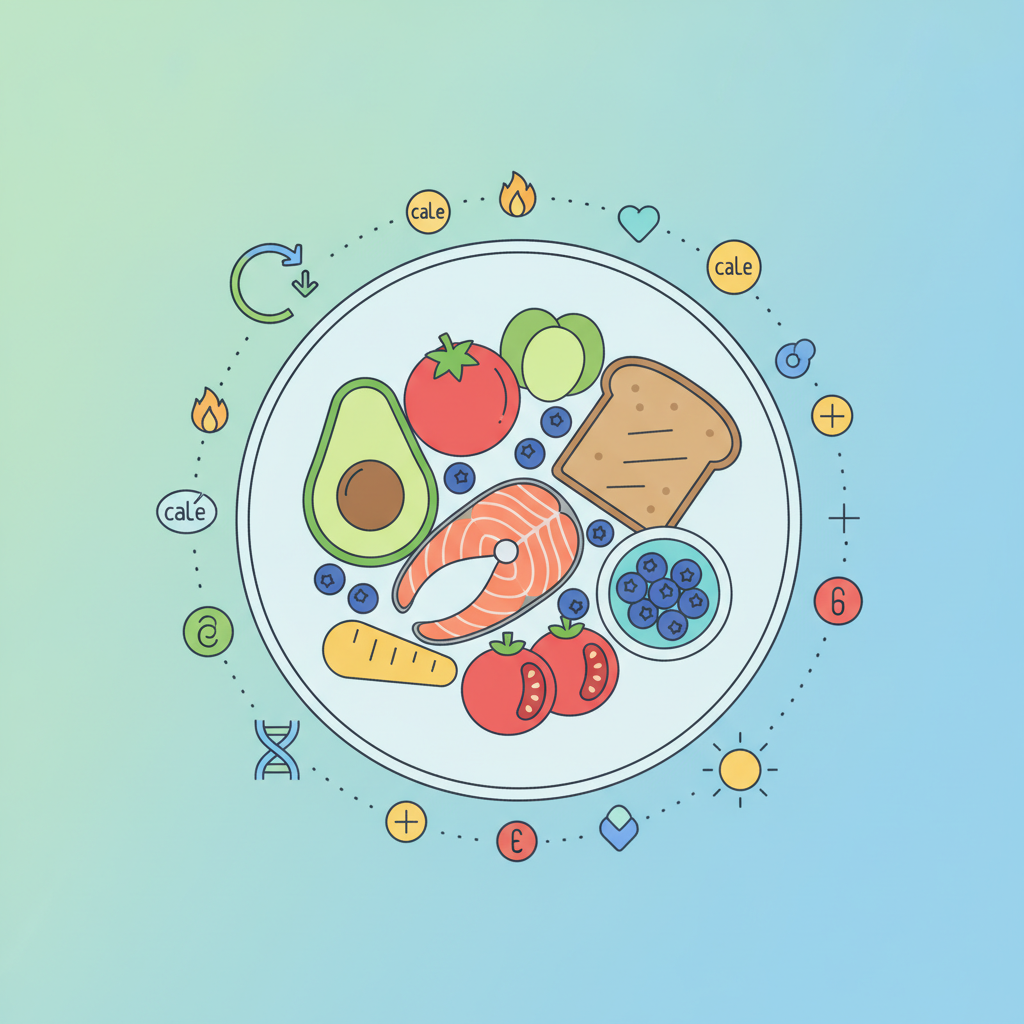
How to Plan Your Daily Diet: A Step-by-Step Meal Plan with Calories and Macros
Eating "roughly right" and eating according to a clear plan are fundamentally different things. With a plan, you know how many calories you will have consumed by evening, you don't wonder what to cook, and you're not choosing between a kebab wrap and an empty fridge. This article provides a concrete, step-by-step breakdown of how to plan your daily diet taking into account your daily calorie target and the balance of protein, fat, and carbohydrates.
Why Plan Your Diet in Advance: The Main Reasons
Most dietary slip-ups happen not from a lack of willpower, but from the absence of a plan. When you're hungry and don't know what to eat, your brain reaches for whatever is most accessible and highest in calories — that's an evolutionary habit, not a personal failure.
Making conscious food choices reduces the likelihood of random snacking. If breakfast, lunch, dinner, and two snacks are already mapped out, there is minimal room for impulsive decisions. You don't find yourself standing in front of a vending machine at three in the afternoon simply because you forgot to bring food with you.
A pre-planned menu saves time. Decision-making is a cognitively demanding process. If you're figuring out what to eat from scratch every day, your mental resources are depleted by evening. A ready-made daily meal plan removes that burden.
A regular structure stabilises your energy levels. Erratic eating triggers blood glucose spikes: a sharp rise after a meal followed by an equally sharp drop, which you feel as fatigue and sugar cravings. Spreading calories evenly throughout the day smooths out those peaks.
Planning lets you control the composition of your meals, not just the quantity. You can eat 1,800 kcal worth of biscuits or 1,800 kcal of chicken with buckwheat and vegetables — the calories are the same, but the outcome for your health, wellbeing, and satiety is completely different. A balanced diet is built on understanding the quality of food, not just its volume.
Step 1. Determine Your Daily Calorie Needs
Before thinking about food, you need to establish a number — how many calories you need per day. Without this, any "healthy" diet is guesswork.
Basal Metabolic Rate (BMR) is the number of calories your body burns at complete rest: breathing, heartbeat, maintaining body temperature. The most accurate practical formula is the Mifflin – St Jeor equation (Journal of the American Dietetic Association, 1990):
- For men: BMR = 10 × weight (kg) + 6.25 × height (cm) − 5 × age (years) + 5
- For women: BMR = 10 × weight (kg) + 6.25 × height (cm) − 5 × age (years) − 161
The result is then multiplied by an activity factor:
| Activity level | Factor |
|---|---|
| Sedentary lifestyle | 1.2 |
| Light activity (1–3 workouts per week) | 1.375 |
| Moderate activity (3–5 workouts) | 1.55 |
| High activity (6–7 workouts) | 1.725 |
| Very high (physical labour + sport) | 1.9 |
The result is your daily TDEE (Total Daily Energy Expenditure). For a detailed breakdown of how to calculate this figure in three steps, see the article "How Many Calories Do You Need Per Day".
From there, adjust your TDEE to match your goal:
- Weight loss: a deficit of 10–20% of TDEE. How to calculate this safely is covered in "Calorie Deficit for Weight Loss".
- Weight maintenance: stay at your TDEE level.
- Muscle gain: a surplus of 10–15% of TDEE.
Step 2. Calculate Your Protein, Fat, and Carbohydrate Ratio
Calories are the quantity; macros are the quality. A proper daily diet is built on both parameters at once. If you want to understand the basic concepts, take a look at the article "What Are Macros in Simple Terms".
Standard ratio for weight maintenance:
- Protein — 25–30% of daily calories
- Fat — 25–30%
- Carbohydrates — 40–50%
How to convert percentages into grams:
- Protein: 1 g = 4 kcal. The recommended minimum according to the European Food Safety Authority (EFSA) is 0.83 g per kg of body weight; with active training — 1.6–2.2 g/kg (meta-analysis in the British Journal of Sports Medicine, 2018).
- Fat: 1 g = 9 kcal. At least 20% of daily calories is the necessary minimum for hormonal balance and absorption of vitamins A, D, E, and K. Priority goes to unsaturated fats.
- Carbohydrates: 1 g = 4 kcal. The primary energy source for the brain and muscles; preference goes to complex carbohydrates with a low glycaemic index.
A detailed macro calculation for a specific goal is described in the article "Daily Protein, Fat, and Carbohydrate Targets".
Adjusting for your goal:
- For weight loss: increase the protein share to 30–35%, reduce carbohydrates to 35–40%.
- For muscle gain: protein — 25–30%, carbohydrates — 45–55%.
Step 3. Choose Your Eating Pattern and Number of Meals
There is no universal schedule. However, three main meals with two snacks is a convenient and well-studied structure that suits most people with a typical lifestyle.
A rough schedule:
- 07:00–08:00 — Breakfast
- 10:30–11:00 — First snack
- 13:00–14:00 — Lunch
- 16:30–17:00 — Second snack
- 19:00–20:00 — Dinner
The key principle is regularity, not a rigid interval. Long gaps without food (6–8+ hours during active hours) raise cortisol levels and trigger overeating at the next meal.
The last meal of the day should be no later than 2–3 hours before bedtime. It's not about the myth of "everything turning to fat overnight" — it's about sleep quality: a heavy meal right before bed disrupts your sleep architecture.
Breakfast is a critically important meal. A study published in the American Journal of Clinical Nutrition (2014) found that people who regularly skip breakfast consume more calories throughout the day and have poorer appetite control.
Step 4. Build a List of Suitable Foods by Category
A good diet is built from a pre-selected pool of foods. There's no need to invent new dishes every day — rotating 15–20 familiar foods is enough.
Protein sources:
- Animal: chicken breast, turkey, eggs, low-fat cottage cheese, fish (cod, salmon, tuna), Greek yoghurt
- Plant-based: chickpeas, lentils, kidney beans, tofu, edamame
Complex carbohydrates:
- Buckwheat, oatmeal, brown rice, pearl barley, quinoa
- Wholegrain bread, durum wheat pasta
- Potatoes (boiled or baked)
Healthy fats:
- Avocado, extra-virgin olive oil
- Nuts (almonds, walnuts, cashews) — no more than 30 g per day due to their high calorie density
- Oily fish (mackerel, salmon, herring)
Vegetables and greens:
- Broccoli, spinach, cucumber, tomatoes, courgette, bell pepper, leafy salads
- Fill half your plate — they add volume with minimal calories
Fruits and berries:
- Apples, pears, blueberries, strawberries, banana — a source of fibre and micronutrients
- Ideally 1–2 portions per day, preferably in the first half of the day
To read labels correctly when buying these foods, use the guide "How to Read a Food Label".
Step 5. Distribute Calories and Macros Across Your Meals
Now put it all together. Suppose your daily target is 1,800 kcal. Here is how to spread them throughout the day:
| Meal | % of daily target | Kcal |
|---|---|---|
| Breakfast | 25–30% | 450–540 |
| Snack 1 | 10% | 180 |
| Lunch | 30–35% | 540–630 |
| Snack 2 | 10% | 180 |
| Dinner | 20–25% | 360–450 |
Breakfast: focus on protein and complex carbohydrates. Example: oatmeal with berries + 2 soft-boiled eggs + coffee without sugar.
Lunch: the largest meal. Combine all three macronutrients. Example: buckwheat + chicken breast + fresh vegetable salad with olive oil.
Dinner: light, with an emphasis on protein and non-starchy vegetables. Example: baked fish + steamed broccoli.
Snacks: Greek yoghurt, a handful of nuts, an apple with cottage cheese.
When cooking at home, it's important to count calories in finished dishes correctly — you'll find a step-by-step guide in the article "How to Count Calories When Cooking at Home".
How to Simplify Diet Tracking: Tools and Habits
Drawing up a diet plan once is not difficult. Sticking to it every day — that is the real challenge.
A few practical tools:
- Food diary. Logging what you eat in real time is the most reliable way to stay on track. Find out how to keep one in the article "How to Keep a Food Diary".
- Meal prep. Prepare base foods in advance — cooked grains, roasted meat, chopped vegetables — and assemble meals throughout the week.
- Ready-made meal templates. When you have 5–6 tried-and-tested breakfast and lunch options, you don't have to think from scratch every time.
- AI-powered calorie-tracking apps. MICO — an AI calorie-tracking app (mico.fit) — lets you recognise dishes from a photo in seconds, log food by voice ("I had oatmeal with a banana and two eggs") or by typing manually. Three AI coaches with different communication styles — caring Mia, strict Marcus, and sarcastic Kai — provide personalised comments on your diet and daily insights. The app hasn't launched yet, but you can already join the waiting list at mico.fit.
FAQ: Common Questions About Planning Your Daily Diet
Do I need to weigh all my food for the plan to work?
Scales are the most accurate tool, especially at the start. However, if that feels too complicated, there are workable alternatives: the hand method (a palm of protein, a fist of carbs, a thumb of fat), volume measures, and visual estimation. Read more about methods without scales in the article "How to Count Calories Without Scales". Even approximate tracking is better than no tracking at all.
What do I do if I'm eating out and don't know what's in the dish?
This is a solvable problem. There are specific techniques: estimating by similar items in a database, asking staff about the main ingredients, comparing visually with known portions. A full guide for this situation can be found in the article "How to Count Calories When Eating Out". The main rule: approximately is better than not at all.
How long does it take to get used to a new diet?
According to a study published in the European Journal of Social Psychology (2010), forming a new habit takes an average of 66 days. The first two weeks are the hardest: the body is adjusting, and the brain resists change. Make this period easier: start with small changes, don't alter everything at once, and use ready-made menu templates instead of improvising every day.
Can I draw up one diet plan for the whole week and simply repeat it?
Yes, and it is even preferable at the start. Rotating 2–3 breakfast, lunch, and dinner options reduces cognitive load and makes calorie counting more accurate — you already know the composition of familiar dishes. Variety matters from a micronutrient perspective, but it's easy to achieve by swapping vegetables and protein sources without changing the entire menu structure.
What do I do if my weight stops changing on the diet I've already planned?
This is called a "plateau" and it happens to almost everyone. The causes vary: a reduced basal metabolic rate, unconscious calorie overruns, or a change in activity level. A breakdown of real causes and solutions can be found in the article "Why Your Weight Stalls on a Calorie Deficit".
🥗 Counting calories alone is boring. MICO has three AI coaches with different personalities — from the supportive Mia to the sarcastic Kai. Join the waiting list →
Be the first to try MICO
AI calorie tracker with a personal coach. Free early access.
Join the waitlist