How to Count Calories Without Scales: Methods That Work in Real Life
Kitchen scales are a great tool. But what do you do at a restaurant, at a friend's place, on a business trip, or simply when weighing every piece of chicken feels physically uncomfortable? The good news is that estimating calories by eye is a real, workable skill. In this article you will find specific methods you can apply today, without a single gram on the dial.
Why Counting Calories Without Scales Is Actually Possible
Many people think that tracking food without weighing it is self-deception. In reality, it is a question of accuracy and goals. If you want to lose weight, build muscle, or simply eat more mindfully, you do not need laboratory precision — you need a good enough estimate that you can maintain consistently.
According to the Academy of Nutrition and Dietetics, even people who regularly weigh their food are systematically off by 10–20% — because they do not account for moisture loss during cooking, residue left in the pan, sauces and dressings. Scales create an illusion of precision, but not absolute precision. This is important to understand: both methods have a margin of error.
Visual portion estimation is a skill that develops over time. The more often you consciously assess the size of a dish and check it against the actual weight every now and then, the more accurate your eye becomes. Research in the field of behavioural nutrition (for example, work by Brian Wansink published in the Journal of Consumer Research) shows that trained observers estimate portion volumes with a margin of around 10–15% — which is a perfectly acceptable range for most everyday purposes.
If you are just starting to explore this topic, we recommend reading the article on what macros and calories mean in plain language first — it will help you build a basic understanding of what you are actually going to be counting.
The Hand Method: The Most Versatile Tool
The hand method is a system of visual reference points where your own hand serves as a measuring instrument. It works on one clever principle: hand size is proportional to body size — and therefore to its needs. A large man has a large palm, so his "palm-sized portion" is objectively bigger than that of a petite woman. The natural scale is already built in.
How to use the hand method in practice:
- Protein (meat, fish, poultry, cottage cheese, tofu) — one portion equals the size of your palm without fingers and roughly the same thickness. That is approximately 85–120 g of food and 150–250 kcal depending on the type.
- Grains, pasta, legumes, starchy vegetables — the reference is one fist (cooked). Approximately 150–200 g of cooked buckwheat or rice, around 150–200 kcal.
- Non-starchy vegetables (cucumbers, salad leaves, cabbage) — there is no need to restrict yourself here, but two fists is a good reference for one meal.
- Fats (butter, nuts, seeds, cheese, avocado) — one portion equals one thumb tip. It sounds small — but that is around 7–10 g of fat, 60–90 kcal. Fats are most often underestimated.
- Snacks and nuts — one handful (what fits in a cupped palm). For nuts that is around 30 g and 170–200 kcal.
The hand method is especially convenient away from home — your hands are always with you. Practise it for at least a week alongside weighing, and you will be surprised how quickly you can calibrate your perception.
Visual Reference Points: Comparing Food to Familiar Objects
Another way to estimate portions without scales is to compare food to familiar objects. This method is known as visual portion cues, and it is widely used in dietetic practice.
Memorise or save this cheat sheet:
| Object | Food | Weight | Calories |
|---|---|---|---|
| Deck of cards | Meat or fish | ~85–90 g | 150–200 kcal |
| Tennis ball | Fruit or boiled potato | ~100–120 g | 80–100 kcal |
| Dice (2×2 cm) | Hard cheese | ~25–30 g | 70–90 kcal |
| Tablespoon | Vegetable oil | ~10–12 g | 90–120 kcal |
| Ping-pong ball | Nut butter | ~30 g | 180–200 kcal |
| Fist | Cooked grain or pasta | ~150–180 g | 150–200 kcal |
Print this table out or save it to your phone. For the first two weeks you will need it actively; after that the images will be fixed in your memory. The method requires nothing except attention.
Measuring Spoons and Cups as an Alternative to Scales
If you do not have scales but do have standard kitchen tools — a measuring cup and spoons — the accuracy of your tracking increases significantly. This is a middle ground between weighing and estimating by eye.
A measuring cup (250 ml) is convenient for dry goods and cereals. One cup of dry oats is about 90 g (340 kcal). One cup of cooked rice is about 200 g (260 kcal). Check the volume against scales for a specific product just once and you will have your own personal reference point.
A tablespoon (≈15 ml) and a teaspoon (≈5 ml) are indispensable for fats and sauces:
- 1 tbsp olive oil — 14 g, 120 kcal
- 1 tbsp mayonnaise — 15 g, 100 kcal
- 1 tsp butter — 5 g, 37 kcal
- 1 tbsp peanut butter — 16 g, 95 kcal
The main tip: weigh your favourite food in your usual bowl or mug just once and remember what it looks like. Your own crockery becomes a personal measuring device. This trick is especially useful for regularly consumed foods — cereals, cottage cheese, yoghurt.
If you are interested in a systematic approach to tracking your diet, take a look at the food diary guide — it explains in detail how to build the habit without stress.
The Plate Method: A Structural Approach Without Numbers
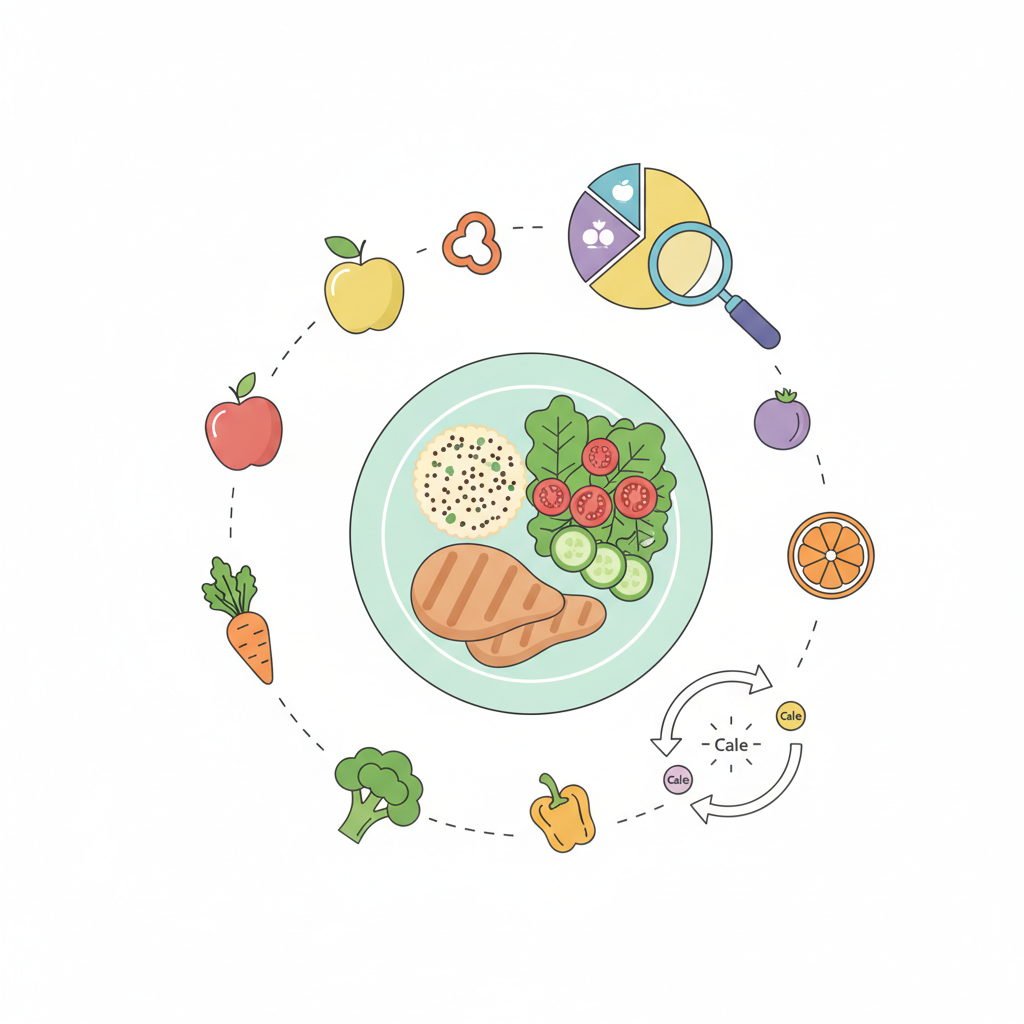
The plate method is perhaps the simplest way to control calorie intake without any counting at all. It is recommended by WHO dietitians and the Harvard T.H. Chan School of Public Health as a basic healthy eating tool.
The principle is simple:
- ½ of the plate — non-starchy vegetables: salad leaves, cucumbers, tomatoes, broccoli, cauliflower, courgettes. They provide volume, fibre and satiety with minimal calories.
- ¼ of the plate — a protein source: meat, poultry, fish, eggs, legumes, cottage cheese. Protein provides satiety and helps preserve muscle.
- ¼ of the plate — complex carbohydrates: buckwheat, brown rice, quinoa, wholegrain bread, sweet potato.
- A small space — quality fats: an olive oil dressing, avocado, a handful of nuts.
With a plate diameter of 23–25 cm, this kind of meal will contain roughly 450–600 kcal — a normal figure for a main meal at an average daily intake. What is particularly good about this method is that it shifts the focus from numbers to composition: instead of "how much?" you think "what is it made of?"
To calculate your personal daily calorie target, use the three-step calorie guide.
Restaurants, Cafés, Someone Else's Kitchen: How to Count Calories Away from Home
Eating away from home is the main enemy of accurate tracking. But that is no reason to give up entirely. Use the "good enough estimate" strategy.
Practical techniques:
- A standard portion as a reference point. In most cafés, a pasta portion is 300–400 g of the finished dish (450–700 kcal), a burger is 450–600 kcal, a portion of blended soup is 200–300 kcal. These figures are a working starting point.
- Restaurant menus and websites. Many chains publish nutritional information. Even if you are at a specific establishment, you can find a similar item in an app or database.
- Split a large portion. If the portion is clearly excessive — ask for half to be packed up, or immediately set it aside for a second meal. This works both as a strategy and as a money-saver.
- Photograph your food. A photo of your plate helps you assess the portion size later. This is, incidentally, exactly the principle behind photo-based food recognition in modern AI apps — you can read more about that in the article on food recognition by photo.
- Watch out for sauces. A Caesar salad with dressing is an extra 150–200 kcal on top of the leaves.
Common Mistakes When Estimating Portions by Eye
Knowing the methods is important. But it is equally important to know exactly where the eye deceives you most often.
Mistake 1: Underestimating calorie-dense foods. Nuts, oils and cheeses are the top underestimated foods. A handful of cashews seems like a light snack, but it contains 180–200 kcal. Always mentally "add" extra calories to fatty products — reality is almost always higher than your first estimate.
Mistake 2: The crockery effect. Food on a small plate looks like a larger portion than the same amount on a big plate. The same quantity of rice in a small bowl looks like "a full plate", while in a large one it looks like a modest side dish. Keep this in mind when assessing volume.
Mistake 3: Ignoring add-ons. Sauces, dressings, cooking oil, soured cream in soup, ketchup — all of these are real calories. Research shows (American Journal of Clinical Nutrition, 2006) that it is precisely the hidden fats in sauces and condiments that cause people to systematically underestimate their calorie intake by 20–30%.
Mistake 4: "Healthy" does not mean "low-calorie". Avocado, olive oil, nuts, granola — these are healthy foods, but they are very high in calories. They need to be assessed just as carefully as chocolate.
Mistake 5: Not counting drinks. Coffee with milk, smoothies, juice, alcohol — these are all calories. A glass of orange juice is around 110 kcal; a whole-milk latte is 150–200 kcal.
If you are just starting to count calories and want to avoid giving up on day two, read the beginner's guide.
FAQ: Frequently Asked Questions
How accurate is the hand method compared to scales?
The hand method gives a margin of error of around 10–20% depending on the food and your experience. For most people who want to maintain a healthy weight or lose weight gradually, this is perfectly acceptable. If your goal requires more precise control — for example, competition preparation — it is better to combine visual estimation with periodic weighing for calibration.
Can you lose weight counting calories without scales?
Yes, and many people do so successfully. The main thing is consistency and attentiveness. The plate method and the hand method together provide a good enough level of control over overall calorie intake. You can read more about how to create a calorie deficit without slip-ups in this article.
How quickly does the skill of visual portion estimation develop?
With regular practice — 2–4 weeks. It is particularly effective to spend the first 7–10 days weighing foods and estimating them visually at the same time: the brain quickly memorises the correspondence between appearance and actual weight. After that, your eye works almost automatically for familiar dishes.
What about composite dishes — soups, stews, casseroles?
For home-cooked dishes it is convenient to calculate the total calorie count for the whole pot and divide it by the number of servings. If you are eating at a café or someone else's home — use the average values for that type of dish and add around 10–15% "for sauces and oil". That is a sensible buffer against underestimation.
Is it even worth starting to count calories if I cannot be precise?
It is. Awareness matters more than precision. Simply paying attention to what you eat already changes your behaviour. A margin of error of 10–15% with a consistent method is not a problem: the body adapts to the system, not to a specific number.
🥗 Counting calories is boring on your own. MICO has three AI coaches with different personalities — from the supportive Mia to the sarcastic Kai. Join the waiting list →
Be the first to try MICO
AI calorie tracker with a personal coach. Free early access.
Join the waitlist